• The definition I use for a state is “a polity, controlled by a single leader or group, that has primary access to the military and fiscal resources of a geographical area.” This is quite distinct from sovereignty https://en.wikipedia.org/wiki/Sovereignty I am concerned with the actual practice of power military and fiscal power, not the current framework of international recognition.

    In today’s world there are places where actual authority does not match UN membership and ISO country codes. For example, Somalia has not been unified since 1991. During the Cold War, the Warsaw Pact members were functionally part of the Soviet Union.

    In future posts, I will discuss edge cases in more detail. As always is the case with edge cases, you may reasonably differ with my classification.

  • I enjoy looking at maps and watching the rise and fall of nations. This dataset will allow that to be done graphically.

    In addition, I play board & computer wargames, which require tha production values and the like be assigned. The data here is useful for that.

  • The second dataset (State-Year) I am creating will have the annual GDP and population information by state. which I define as a polity, controlled by a single leader or group, that has primary access to the military and fiscal resources of a geographical area.

    This will involve tracking control of geography. For each country defined by Maddison/HYDE data, I am defining a number of “cities”, which will be assigned a proportion of the “country”. This will allow me to add up the information by “state”.

    The information for State-Year comes from a number of sources. The Wikipedia provides the most information often having information that is missed by map-based sources. Note that non-English Wikipedias have information not in the English Wikipedia.

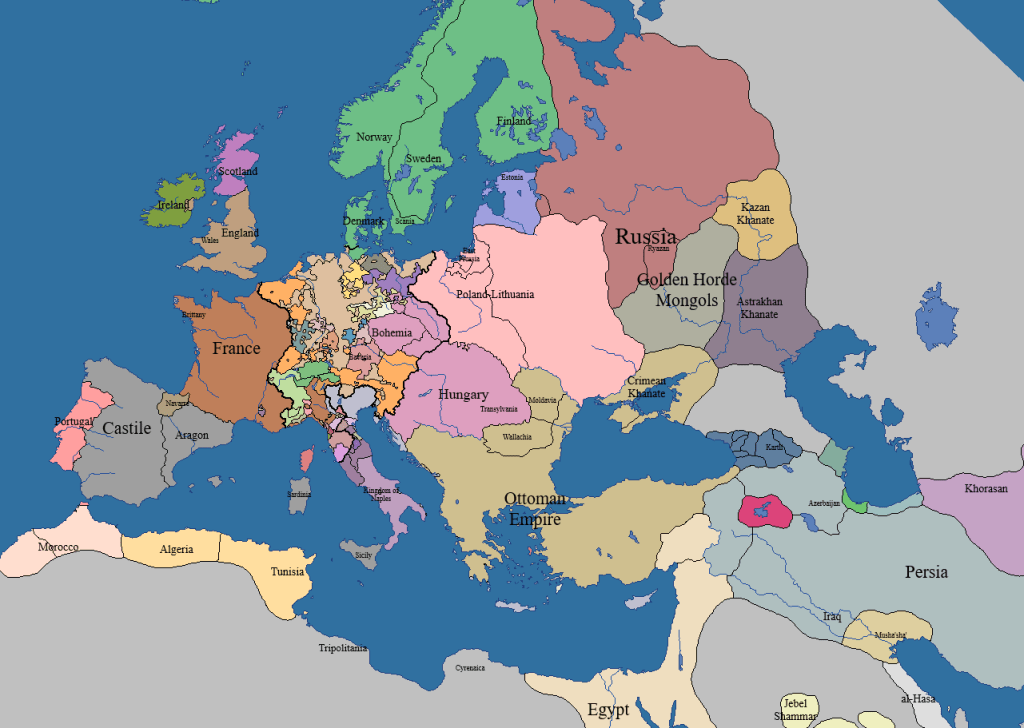
    The Centennia Historical Atlas https://historicalatlas.com/, provides detailed coverage of Europe, North Africa and Southwest Asia from 1000 CE to 2003 CE. Here is 1500 AD

    The website http://geacron.com, has maps from 3000 BCE to today. It covers the entire world but with less detail than Centennia. Here is Europe and adjacent areas in 1500 CE.

  • The population numbers in Country-Year data came from the HYDE project, with data interpolated for the missing years. The GDP numbers came by interpolating the GDP/capita data from the Maddison database and multiplying it out. All numbers were normalized against the world totals.

    Numbers from before the first entry for each country were extrapolated backwards assuming a 2% growth rate back until the subsistence level is reached. Note that I am using $400 (1990)/year subsistence level from the first version of the database rather than $691 level from the second. The $691 level had too many countries at below subsistence. The 2% growth rate seems to give reasonable results.

    Note that pre-industrial economies were never much above subsistence and the GDP proportions are effectively population proportions sufficiently back in the past.

  • The World Historical Economic Database is a dataset I am developing showing GDP and population as a proportion of the world total. There are two distinct datasets.

    The first dataset uses today’s boundaries (mostly). It can be found in the downloads section.

    The second dataset uses the boundaries in effect at the time. It is in the process of development.

    The first dataset was created by interpolating and extrapolating the data from the Maddison database https://www.rug.nl/ggdc/historicaldevelopment/maddison/ and the HYDE model https://hyde-portal.geo.uu.nl/. My data would not be possible without the effort made by these two groups.

  • I have reactivated my dormant website and will use it primarily to present information on my World Historical Economic Database project.

  • Welcome to WordPress! This is your first post. Edit or delete it to take the first step in your blogging journey.